





Research
Using AI to Help New York City Prepare for Hyperlocal Flooding
Lead Researcher: Anita Raja, Ph.D.,
Institution: Hunter College and The Graduate Center, Professor of Computer Science
Why It Matters
As climate change increases the frequency and intensity of heavy rainfall, hyperlocal flooding is becoming a growing challenge for New York City. Unlike coastal storms, inland flooding can develop quickly, affecting individual streets and neighborhoods with little warning.
Emergency managers must make rapid decisions about where flooding is likely to have the greatest impact, when alerts should be issued, and how limited personnel and equipment should be deployed. While existing forecasting systems can estimate where flooding may occur, they often provide limited guidance on how to prioritize emergency response.
Researchers under the direction of Prof. Anita Raja at Hunter College are developing RAFT (Resilient Agents for Flood Tracking) to help transform real-time flood information into faster, smarter decisions that improve public safety and strengthen the city’s resilience.
The Approach
RAFT is an AI-powered decision-support system that combines machine learning with a digital twin of New York City’s flood environment. Rather than simply predicting where flooding may occur, RAFT is trained to weigh the tradeoffs emergency managers face: it evaluates which events are likely to have the greatest impact and recommends how emergency alerts and limited response resources should be prioritized.
The platform is expanding to continuously integrate information from multiple sources, including FloodNet water-level sensors, weather forecasts, flood vulnerability data, rainfall measurements, infrastructure information, and 311 reports.
A key component is FloodNet, New York City’s real-time flood monitoring network, developed by CUNY and NYU researchers and operated by the New York City Department of Environmental Protection. Using reinforcement learning, RAFT continuously improves its decision-making by balancing early detection, alert accuracy, and efficient allocation of emergency resources.
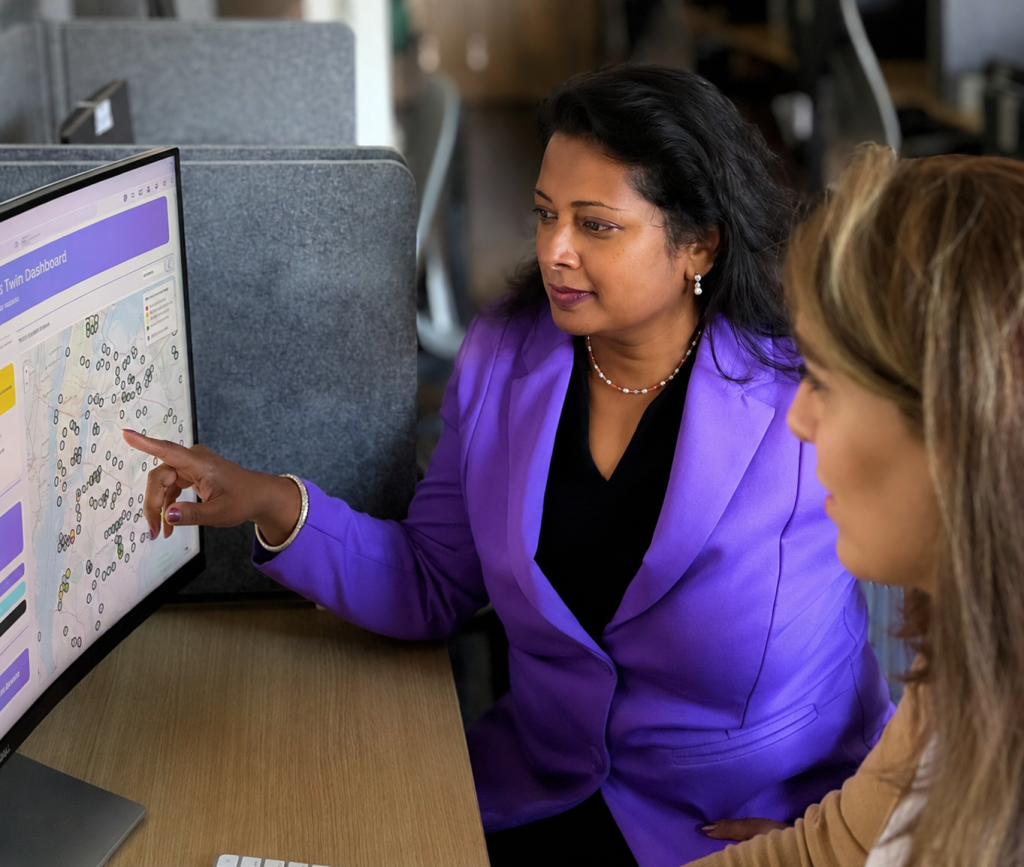
Beyond flood prediction, the research team is developing an interactive digital twin—a virtual representation of New York City’s flood conditions that updates continuously with live data.
The digital twin brings together sensor information, AI predictions, and simulation tools into a single platform where researchers and emergency planners can evaluate how different storms, infrastructure improvements, and response strategies might affect neighborhoods before real-world decisions are made.
The team is also expanding RAFT into a multi-agent system that enables multiple AI agents to coordinate emergency response under changing conditions and limited resources. Together, these capabilities support both immediate operational decisions and longer-term infrastructure planning for a more resilient city.
How Empire AI Makes This Possible
Empire AI provides the computational foundation needed to transform RAFT from a research prototype into a city-scale decision-support platform.
Using Empire AI’s H100 GPU nodes, the RAFT team packaged its training environment as a portable container and cut individual training runs from the better part of an hour on local hardware to under twenty minutes. That speedup has let the team test several model configurations side by side, compare its reinforcement-learning agent against simpler rule-based alerting, and diagnose and correct issues in the training process, iteration that would not have been practical without dedicated compute access.
For New York City, the result will be an AI-powered platform capable of supporting earlier warnings, more effective deployment of emergency resources, and data-driven planning for future infrastructure investments. Empire AI is not simply providing computing resources—it is enabling a new generation of AI research that would otherwise be impossible at this scale.
Potential Impact
RAFT has the potential to change how cities prepare for and respond to flooding.
Rather than reacting after floodwaters begin to rise, emergency managers could use AI-driven forecasts and simulations to anticipate where flooding is likely to have the greatest impact, deploy resources more strategically, and issue more targeted public warnings.
The same digital twin can also help planners evaluate long-term infrastructure investments by simulating how drainage improvements, sensor placement, or emergency response policies could reduce flood risk before those investments are made.
As extreme rainfall events become more common, tools like RAFT could help communities become more resilient while improving public safety and making better use of limited public resources.
Building New York’s AI Workforce
Beyond its research contributions, RAFT is helping prepare the next generation of New York’s AI workforce.
The project brings together students at multiple educational levels, including Ava Yahyapour, a doctoral student from the CUNY Graduate Center and Hunter College, Denisa Cakoni, an undergraduate student from The City College of New York, and Jason Marquez, a high school student from The Bronx High School of Science. Two undergraduate Hunter College Computer Science students Umar Faruque (’25) and John Lee ’26) worked on the initial versions of this project and have since moved to careers in industry. Working alongside Professor Raja, they gain hands-on experience in artificial intelligence, reinforcement learning, data science, and climate resilience.
This vertically integrated research team strengthens collaboration across New York City’s public educational institutions while providing students with practical experience applying AI to one of society’s most pressing challenges.