Research
Using Machine Learning to Boost Chemical Manufacturing Efficiency
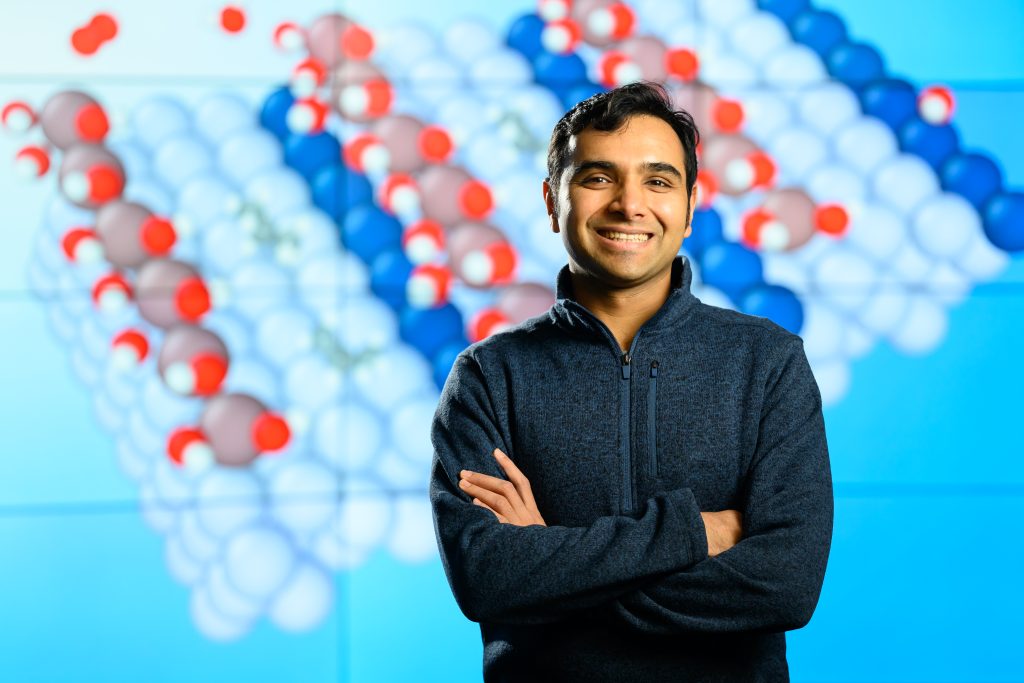
Lead Researcher: Siddharth Deshpande, Assistant Professor of Chemical Engineering
Institution: University of Rochester, Hajim School of Engineering & Applied Sciences
Why It Matters
Many important technologies depend on complex chemical reactions occurring at the surfaces of materials, from batteries that store energy to catalysts used in chemical manufacturing.
Understanding these reactions at the atomic level could help scientists design better batteries, capacitors, catalysts and other materials. But accurately simulating what happens when atoms, molecules and surfaces interact requires enormous computing power.
Siddharth Deshpande and his research team at the University of Rochester are combining machine learning with physics-based modeling to find faster, more efficient ways to understand these interactions. Their goal is to explore chemical systems that historically have been too complex or computationally expensive to study in detail.
The Challenge
For decades, scientists have relied on a computational quantum-mechanical method known as density functional theory (DFT) to study the structure and behavior of materials. DFT allows researchers to model interactions that can be difficult to observe directly, making it an essential tool in computational chemistry and materials science.
But DFT calculations are computationally intensive. As chemical systems become larger and more complex, the number of possible configurations researchers need to consider can grow dramatically.
That has limited scientists’ ability to use DFT for especially challenging problems, including interactions between electrodes and electrolytes in batteries, between solvents and surfaces in catalytic reactions, and within complex materials such as alloys.
Deshpande’s team is developing algorithms to make DFT more efficient while incorporating machine learning and artificial intelligence into these simulations.
The Approach
Rather than attempting to calculate every possible interaction, the researchers combine chemistry, physics and data-driven methods to identify the interactions that matter most.
Machine learning can help narrow the enormous number of possibilities researchers need to investigate, allowing computing resources to focus on the chemical configurations most likely to provide useful information. This approach could enable scientists to investigate much more complicated chemical environments while retaining the insights provided by physics-based modeling.
One area of particular interest is what happens at electrified interfaces—the boundary where an electrode interacts with its surrounding chemical environment. These interfaces are critical to batteries, capacitors and catalytic processes, but their behavior can be extremely difficult to model.
How Empire AI Makes This Possible
Empire AI is dramatically increasing the scale at which Deshpande’s team can conduct these simulations.
Before using Empire AI, the researchers could typically complete approximately 100 to 200 DFT simulations per week. With Empire AI, they can conduct approximately 1,000 simulations per week.
That increase is especially important for machine learning, which depends on having sufficient high-quality data to identify patterns and make useful predictions. By generating many more physics-based simulations, the researchers can build larger datasets, improve their algorithms and investigate chemical systems that previously were impractical to explore.
Empire AI’s GPU computing capabilities are also enabling the team to combine computational chemistry with AI-driven methods at a much greater scale. Rather than simply making existing calculations faster, the additional computing capacity expands the range of scientific questions researchers can investigate.
What Researchers Are Learning
The team has begun investigating the dynamics of cations—positively charged ions—at electrified interfaces, an area that has not previously been explored in depth.
These analyses could help scientists better understand the role solvents play in electrochemical systems.
Researchers seeking to improve batteries and catalytic systems often focus on changing the electrode or catalytic material itself. Deshpande’s work could provide another option: modifying the surrounding solvent to influence how the system behaves.
That could effectively give researchers an additional “tuning knob” for designing more stable and effective electrochemical devices.
Potential Impact
A better understanding of interactions among electrodes, catalysts, solvents and other materials could ultimately improve the performance and stability of batteries, capacitors and catalytic systems.
The research could also change how scientists discover new and improved materials. By combining machine learning with rigorous physics-based simulations, researchers could explore a much larger range of possible chemical systems computationally before determining which are most promising to test experimentally.
For industries that depend on catalysts and electrochemical processes, more efficient computational discovery could help shorten the path from scientific insight to improved materials and technologies.
Just as importantly, Empire AI is giving academic researchers the computing capacity to investigate scientific questions that previously were limited by access to advanced computing resources.